
Advanced Swim Testing Protocols
Lactate Testing For Swimming

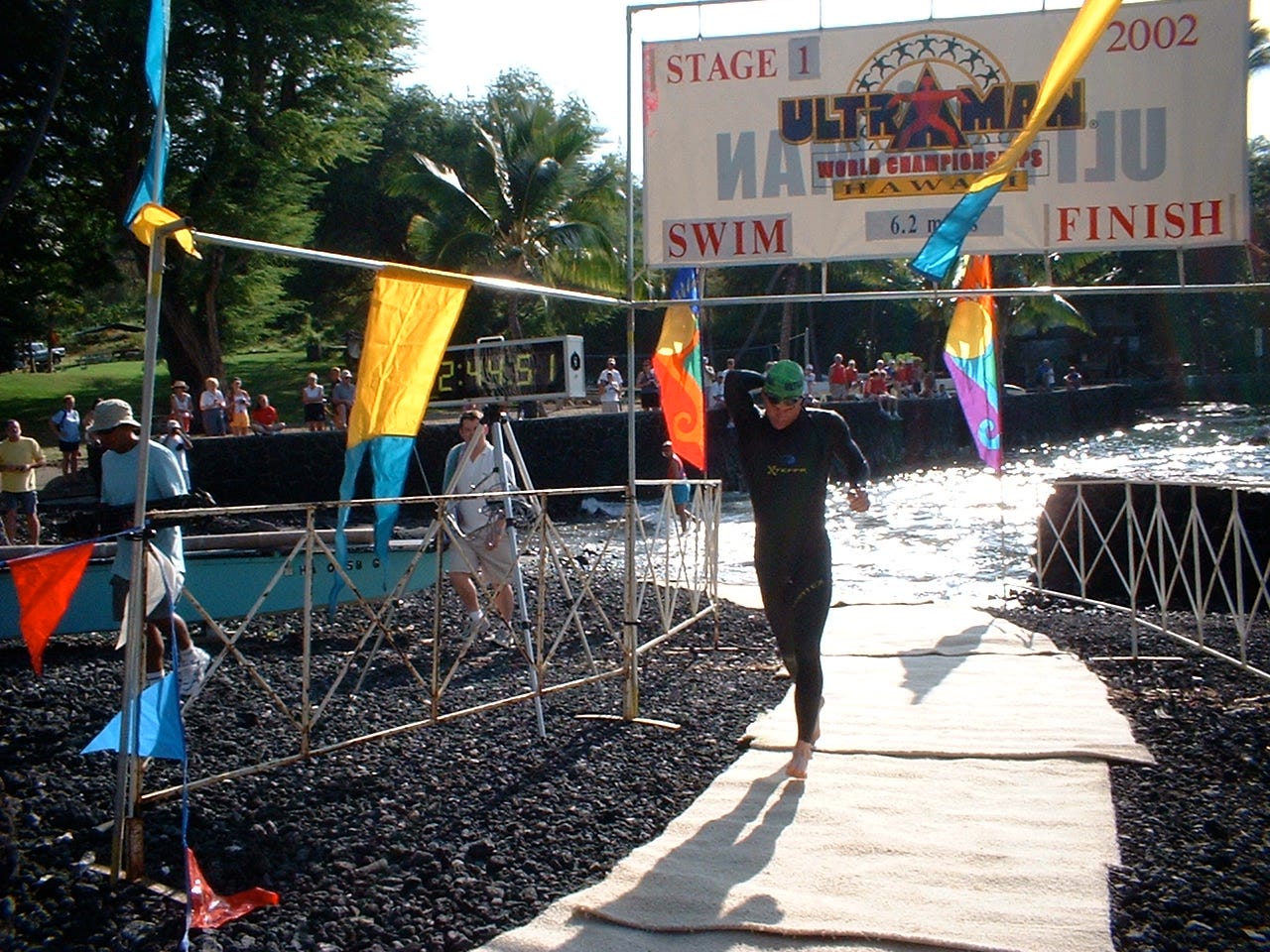
When it comes to adult-onset swimming, I know what you’re going through and how to improve.
I started swimming just before my 30th birthday and was awful1. Despite being awful (to start), I trained myself to:
A 19:59 1500m time, LCM.
A sub-50 minutes Ironman swim.
A 10 km open water swim where I led out the Ultraman World Champs and broke the, then, Day One bike record.
Swim Resources
Let’s start by giving you the key stuff I’ve published so far.
What Moves The Needle
The key lessons I’ve learned from coaching hundreds of adult-onset swimmers:
Swim more often.
Remove gaps, ie non-swimming weeks.
Get someone to video you in the water.
Relax and switch to 3-stroke breathing.
If you swim in a squad then move down a lane.
Use less gear for your main sets.
Always pace so you could speed up at the end.
Add a weekly, continuous easy swim.
Add 15 minutes to your longest swim.
None of these require you to work harder.
Starting To Benchmark
This is from our Swim Chapter section called, Benchmarking Your Swim.
The workout is simple. 5x 400 on short rest. Swim each one a little quicker than the previous.
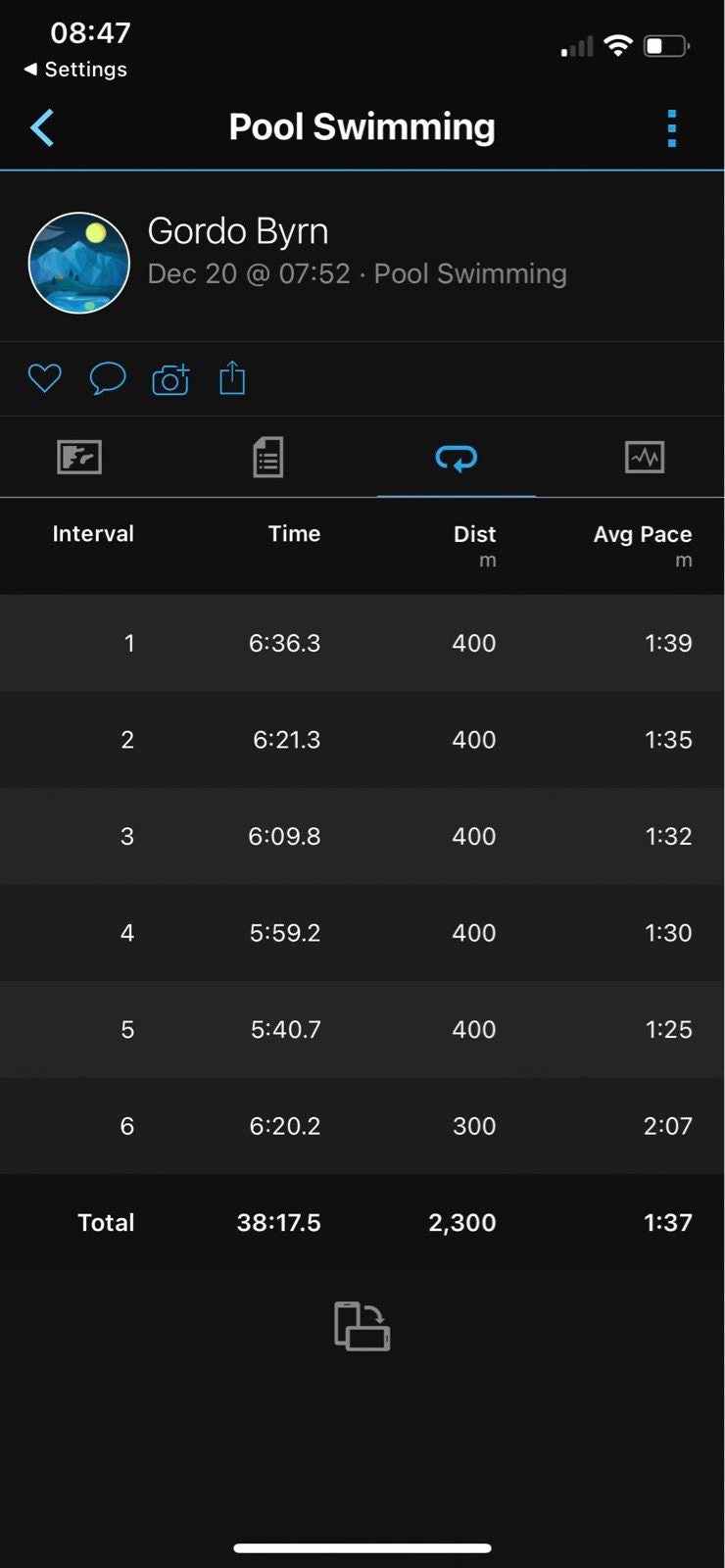
If you can’t speed up for each of the five 400s then you should assume that you do not have a Green Zone when you are swimming. All your swimming, even if it feels easy, is internally stressful. You’re likely to notice this via fatigue and increased appetite when you swim.
If that sounds familiar then have a look at the Swim Game section of our chapter. It will help you relax and learn to better control your efforts, while improving your swim fitness.
There’s more on my video channel. Here’s a link to a “swim” search.
Lactate Testing For Swimming
The 5x400 test works great for getting a rough idea about paces and training zones. However, it doesn’t give any insight into what’s happening inside the athlete. As well, because it is a “test” most athletes are doing to start at a Zone 2 effort (or higher).
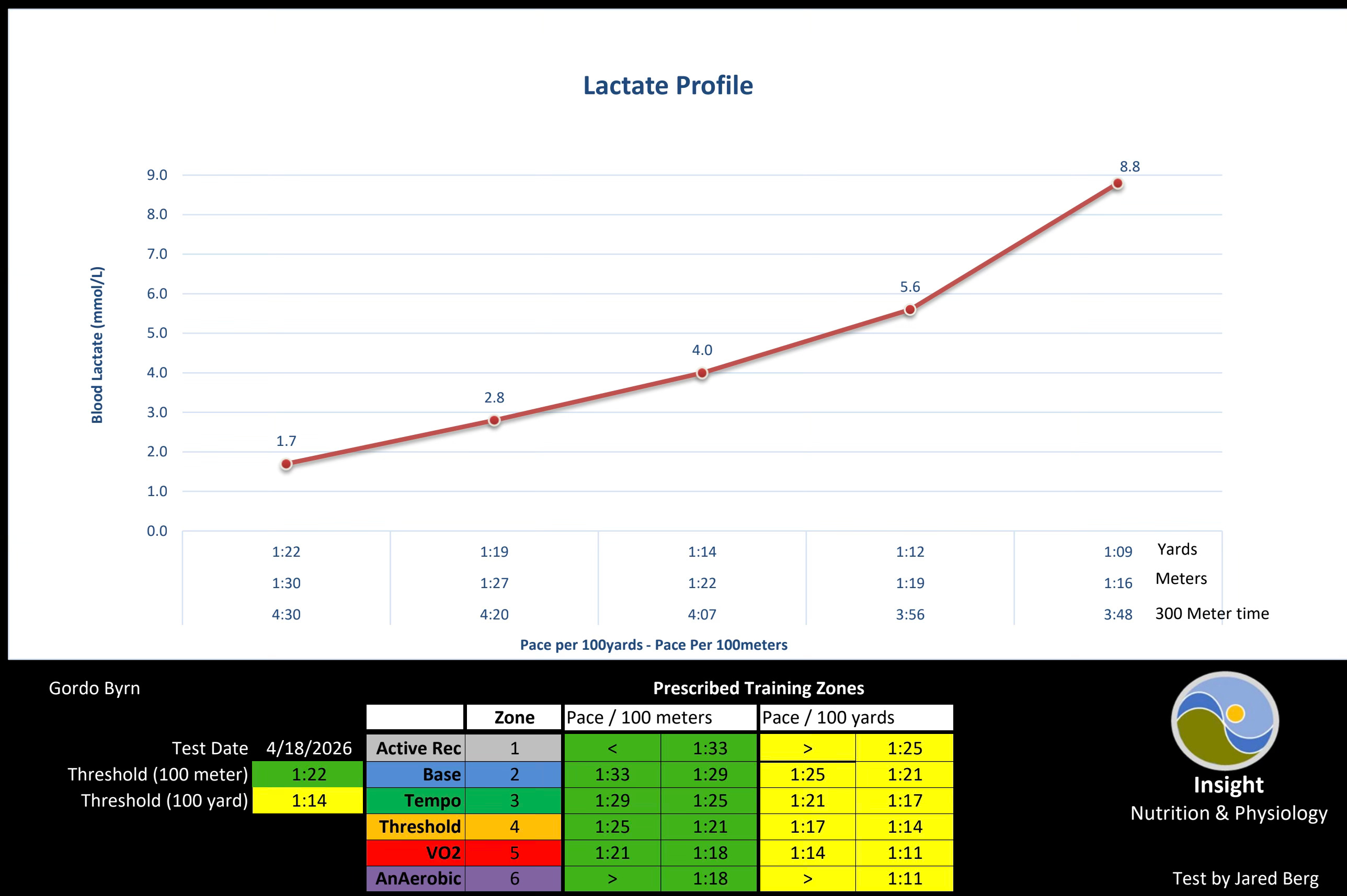
From a recent swim lactate test of mine. Like many of you, the linear lactate curve indicates I started at a Zone 2 effort. The slowest pace in the test was 1:30 per 100 meters and I have the ability to swim at 1:35 and 1:40 per 100 meters. When we test again, I’ll aim for 7 steps. It will go 1:40, 1:35, 1:30, to start.
I like to see multiple steps at a flat baseline and see what it takes to bottom out lactate. Even experienced swimmers may find they don’t have the ability to bottom out lactate (ie get it below 1.5 mmol). If that’s the case then there is material upside from improving metabolic fitness by slowing down for a good chunk of your endurance work. This is even more important for triathletes and swim-runners.
The main set we used in the test:
5x 300 on 1 minute rest (sample lactate).
Descend each 300 by feeling Zone 1 to Zone 5.
Swim as long as required to get lactate <= 3 mmol.
This took me 25 minutes, quite a while.
Slow clearance from hard efforts has important implications for fueling, pacing and energy management in long races.
5x 100 Upper Zone 3 pace on 25-30 seconds rest.
This was swum 1:20 per 100m, leaving on 1:45.
My lactate rose back into Zone 4, above the Golden Zone limit of 3 mmol.
This indicates it’s OK for me to slow down most of my main sets.
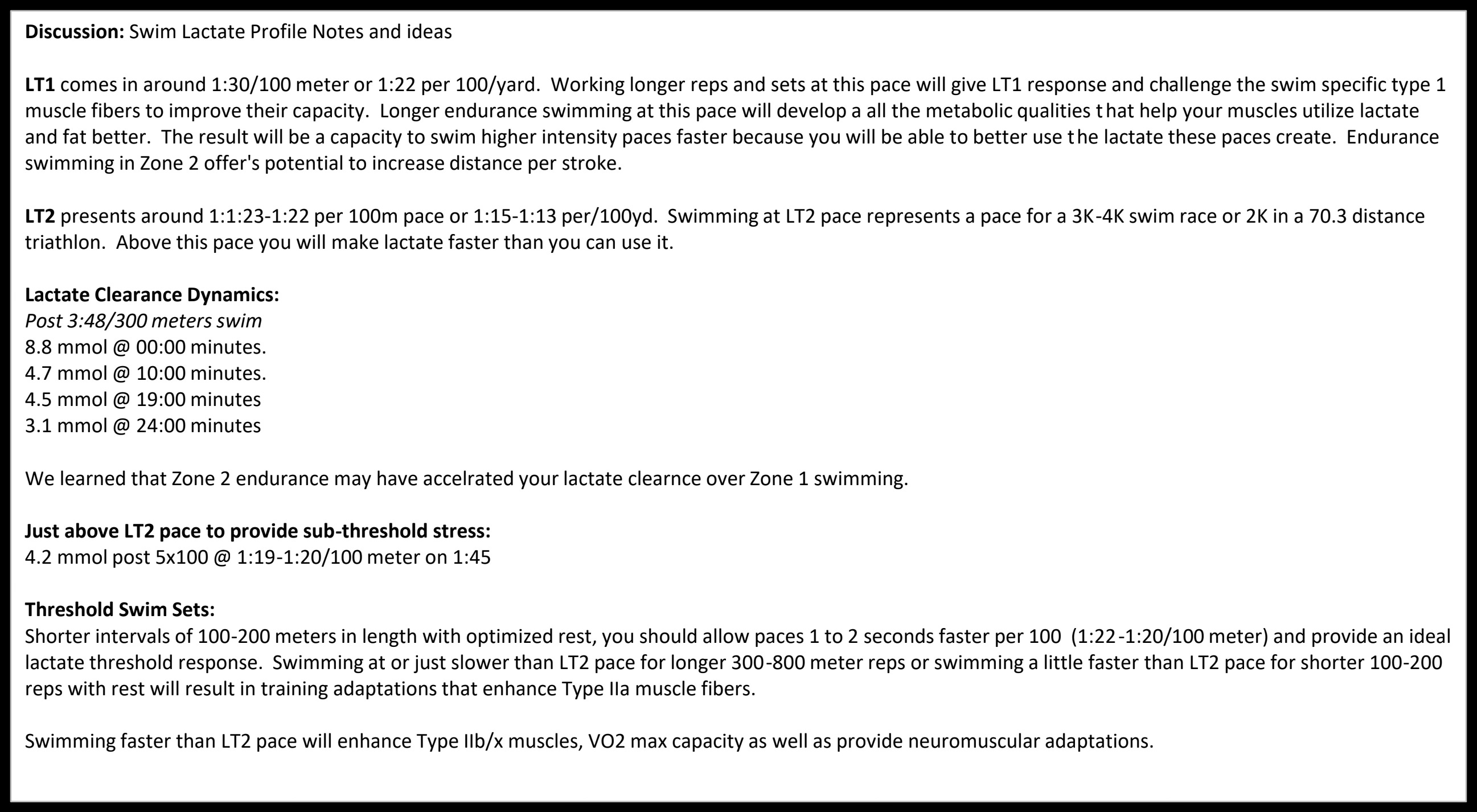
Jared’s assessment of my results.
Next, we want to compare our test results to a couple things:
What speeds am I actually swimming in open water?
Ideally, non-drafting benchmarks to get a clear comparison with the pool results.
Where is the mismatch between training and racing paces?
What does my training mix look like in the pool?
Just like open water, we need an honest assessment when leading a lane, or swimming 10 seconds back.
When you consider these questions, you will find gaps. I sure did. I’ll walk you through common scenarios. I’ve coached, and lived, all of these.
The Missing Middle - My Current Profile
Your honest assessment may uncover a binary approach to swim training.
I discovered was either Zone 1 (slower than 1:30) or Red Zone (Lactate above 5 mmol). This wasn’t a surprise, it was the reason I asked for the test.
Lactate Always Up - My Profile When I Started
The swimmer who wants to make their pool time “count.”
Their first sample will be close to 3 mmol and they will tell you they are swimming easy (geez!). Maybe you have bad strips… Did you calibrate the lactate meter…
I’ve been there. When I returned to swimming, and self tested, my lactate was always up. Eventually, I gave up and stopped testing.
A million meters after giving up, I was fit enough to produce a linear lactate curve. I have a lot of upside, and so do you - if we are willing to back off for a portion of our swim training.
Triathletes Who Fade on the Run
If you’re fading at the end of your races then you should not be reinforcing poor pacing with fast pool swimming.
You will create all kinds of stories to explain why you don’t need to back off in the water. You will love hard training.
Until you’re running well, it’s all BS.
FWIW, I didn’t used to fade on the run. I would blow up so badly by the end of the swim, I would be recovering on the bike then run great. Go figure…
Triathletes Who Swim Slower In Open Water
Remove the walls, remove the draft from swimming in a conga line, make the “workout” a continuous swim without rest… and our true steady-state fitness is revealed.
If you have a large gap between training paces and racing paces then your program is top heavy. Keep one peppy day and shift the rest towards endurance and strength.
Working harder won’t close the gap between the pool and your races.
There Is A Cost To Everything
The individual prescription will depend on the time of year and whether the athlete would benefit from allocating energy to other things.
What other things? Getting tired in the pool means less energy is available for:
Healing injuries.
Immune system function.
Improving cycling and running.
Getting stronger.
Adapt to all other forms of stress.
If you’re having fun and improving then focus on that. Your approach is working.
When you plateau, come back to this article for ideas on how to breakthrough to the next level.
Back to eBook Table of Contents
How awful? It was months before I could break 2 minutes for 100 meters.