
How To Train - Chapter Seven
The Return to ÖtillÖ

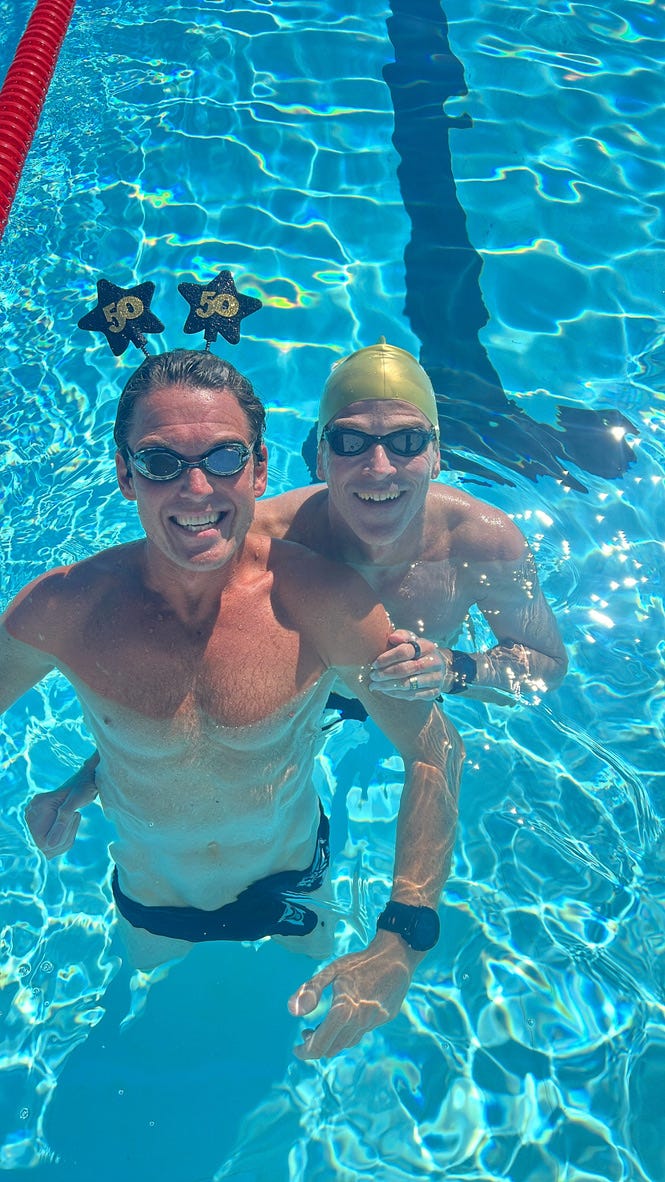
In 2022, I saw the training required for Johan to finish in front of Colting at the ÖtillÖ World Champs. I also got a chance to check out Colting’s fitness when Axel and I visited his hometown of Borås. Putting everything together, I figured I’d be able to keep up as part of Team Colting. I also knew that signing up for a long event would motivate me to swim lots. To return to racing, my big picture strategy was swim, then bike, then run.
The Big Picture
Let’s break down my return to racing.
Get Strong – My Hybrid Athlete Phase, Five Years
Establish My Basic Week – First Six Months
Return To Balanced Training – Second Six Months
Swim Endurance – Third Six Months
Bike Endurance – Fourth Six Months
Run Endurance – A Work in Progress
By using the above approach, I take the immediate pressure off myself to solve my running issues. Both swimming and cycling are well tolerated (by everyone) and that buys time for biomechanical fitness to improve, hopefully.
How long you spend on each phase will depend on many factors. Even in a focus block, I hit my minimums in each sport. The difference is where my fatigue is being generated. For example, in a swim endurance phase, my fatigue is coming from pushing swim volume up, not from swimming fast.
My phases last six weeks to six months. How long should your phases last? You will likely find a seasonal approach works best.
Here’s an example for triathlon:
Fall is for rejuvenation.
Winter is about swimming and general strength.
Spring is good for sport-specific strength.
Summer is the easiest time of year to build volume.
Using phases in your training is called block periodization and doesn’t need to be complex. In fact, you’ll do best by keeping things simple, hitting your minimums and focusing on one (maybe two) aspect(s) of your fitness at a time.
Fitness is built on compounding, not complexity.
Team Jonas and Gordo
Colting wanted to call us Team Old and Slow but race management, to my relief, entered us as Team Jonas and Gordo.
If you think back to Chapter Five, it’s the end of June 2023 and I’m injured. I have ten weeks to get ready for a one-day event that consists of 60 km (37 miles) of running and 9 km (5.6 miles) of swimming across 24 islands in Sweden.
I clear my calendar (extract below). My motto is: Stay Put & Train.
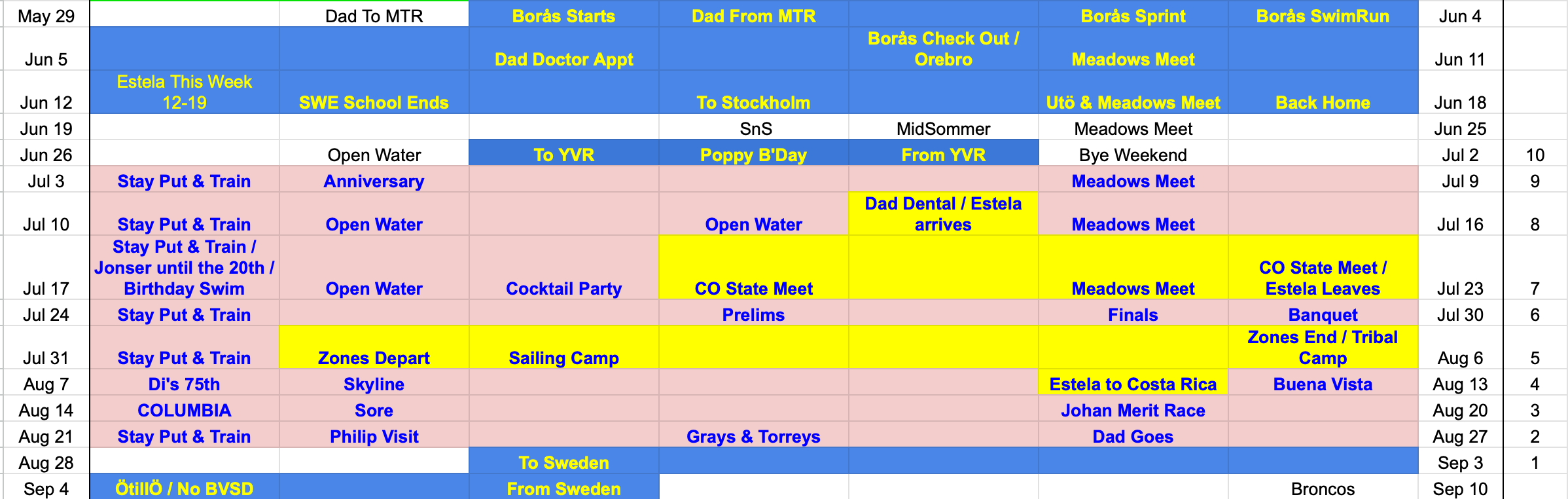
There’s no way I am going to be ready to race World Champs, but I don’t need to race. What I need is enough fitness to keep up with Colting.
I consider my partner’s fitness profile:
Colting is a strong swimmer, which I saw first-hand when we did a 50x100 meter main set on his birthday.
With two young kids, and a pregnant wife, Colting’s time to train is limited.
I consider my fitness profile:
I’m an injured, and injury prone, runner with an excellent tolerance for hiking.
I haven’t done a long event in more than a decade.
My metabolic fitness (swimming and overall) is likely poor.
My strategy:
Build metabolic fitness with cycling.
Train whole-body fitness by combining swim, bike, run and weights sessions on a single day.
Schedule special events where I hike, or ride, for a long time.
Use frequent, short runs.
To help you understand how to apply these techniques, I’ll give you examples from July 2023. After I do that, I will explain my final month of training and walk you through the race, including lessons learned.
