How To Train - Chapter Twelve
Hard and Fast Are Not The Same Thing

A concept that’s critical for you to achieve your potential: in the context of your goals, what is fast? When you answer, be as specific as possible.
In the Alpe Tri, I wanted to ride Tempo / Zone 3 power for 10,000 feet of climbing, split across five hours, then run Steady / Zone 2 pace for 90 minutes. I knew I needed to do this at end of training camp, with only two easy days before the race.
To go fast on race day had little to do with my capacity for hard training.
The key components:
Multi-day, and all-day, general capacity.
Specific capacity for efficient climbing in Zone 3.
Durability to run hills after a long day of climbing.
When endurance athletes think fast or hard, our minds are unlikely to land on the key components of our races. Fast and hard are words we use to describe the Red Zone, Zones 4 and 5, and that can lead our training focus astray.
During my torque and tempo block, I’d managed to complete 80 minutes of Zone 3 power in the final workout. This session was done at an average power of 250w, with moderate heart rate and lactate responses. I figured 250w was my best-case scenario for the Alpe Tri. I would need to more than double the duration on race day, then run. I thought it was likely I’d end up riding easier. But first, I needed to build the fitness to handle the vertical, at any speed. Fortunately, Boulder has a ton of long climb options.
Arriving home from Finland, I had four weeks until it was time to leave for Epic Camp. My time in Sweden and Finland had left me refreshed and ready to get back to work. Scheduling downtime, especially at sea level, speeds my recovery. Two - or more - easy days before returning home from a training camp makes a difference. At a minimum, before you travel, taper out of the high load at camp.
Many athletes fatigue-load before travel. Knowing they will not be able to train during travel, and that they are likely to be disrupted for a few days on arrival, they stack load in the final few days before their trip begins. This is a mistake because we never want to visit an airport tired and, on the return leg, we don’t want to come home exhausted. Returning home, we are always greeted by a long list of catch-up tasks.
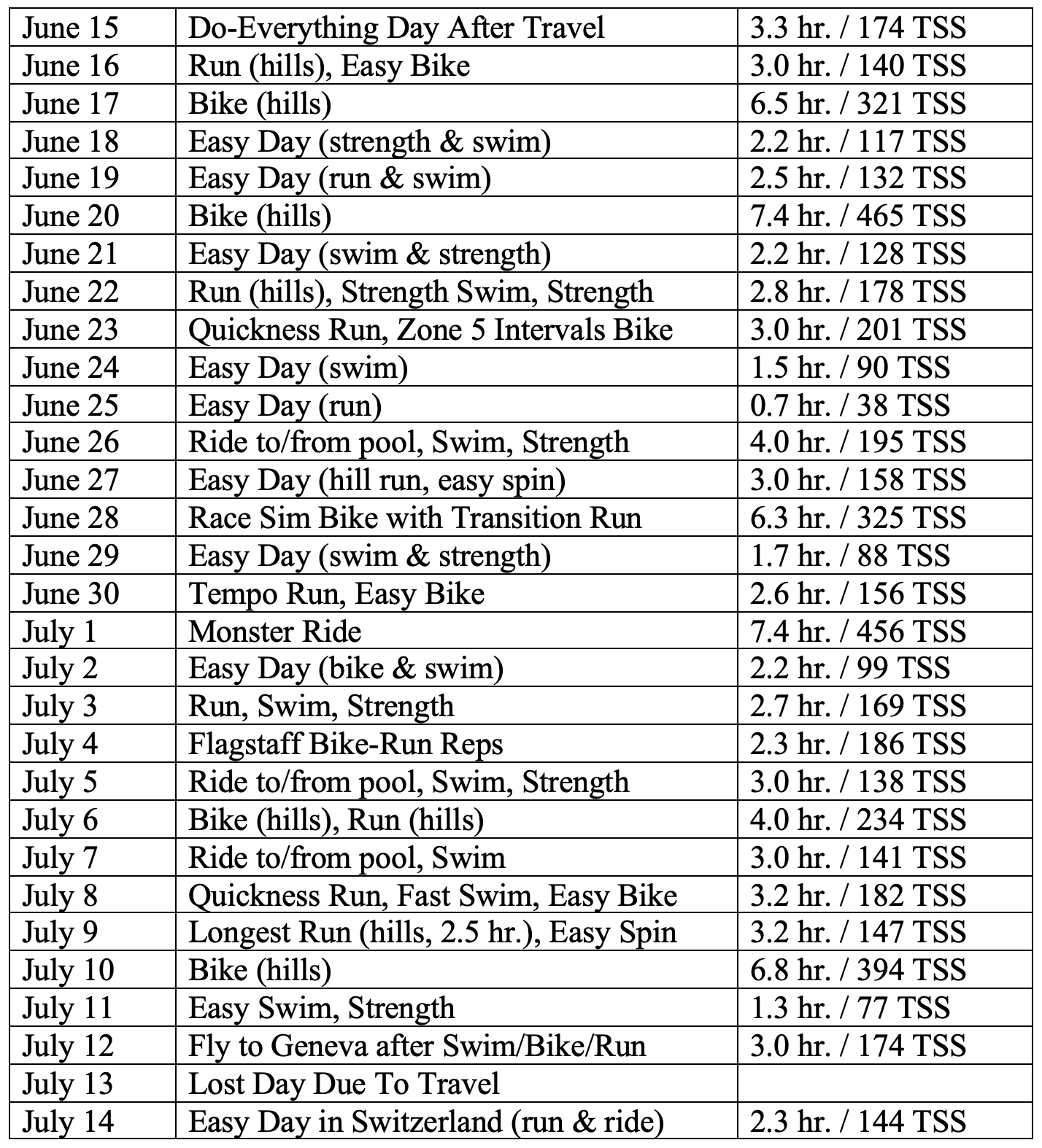
The training block (summarized below) went well. I was able to hit my key sessions, stayed in a good mood, and responded across the block. My general capacity had improved so I only needed two easy days after my key loading days. I also had the capacity to mix in Zone 3, 4 and 5 training.