
Illness Checklist
Keeping Small Setbacks Small

The Checklist
I talk someone through this article at least once a month. Sometimes the someone is me. 😉
Backoff at the first sign of illness.
Minimize the depth of the illness.
Focus on health.
Add back frequency.
Add back volume.
Check lactate response.
Resume normal training.
Tame The Compulsion to Train
What you want to avoid is the pattern outlined in Training For The Uphill Athlete. The book is a valuable resource for all types of endurance athlete. I strongly recommend it to you. You can find my review here.
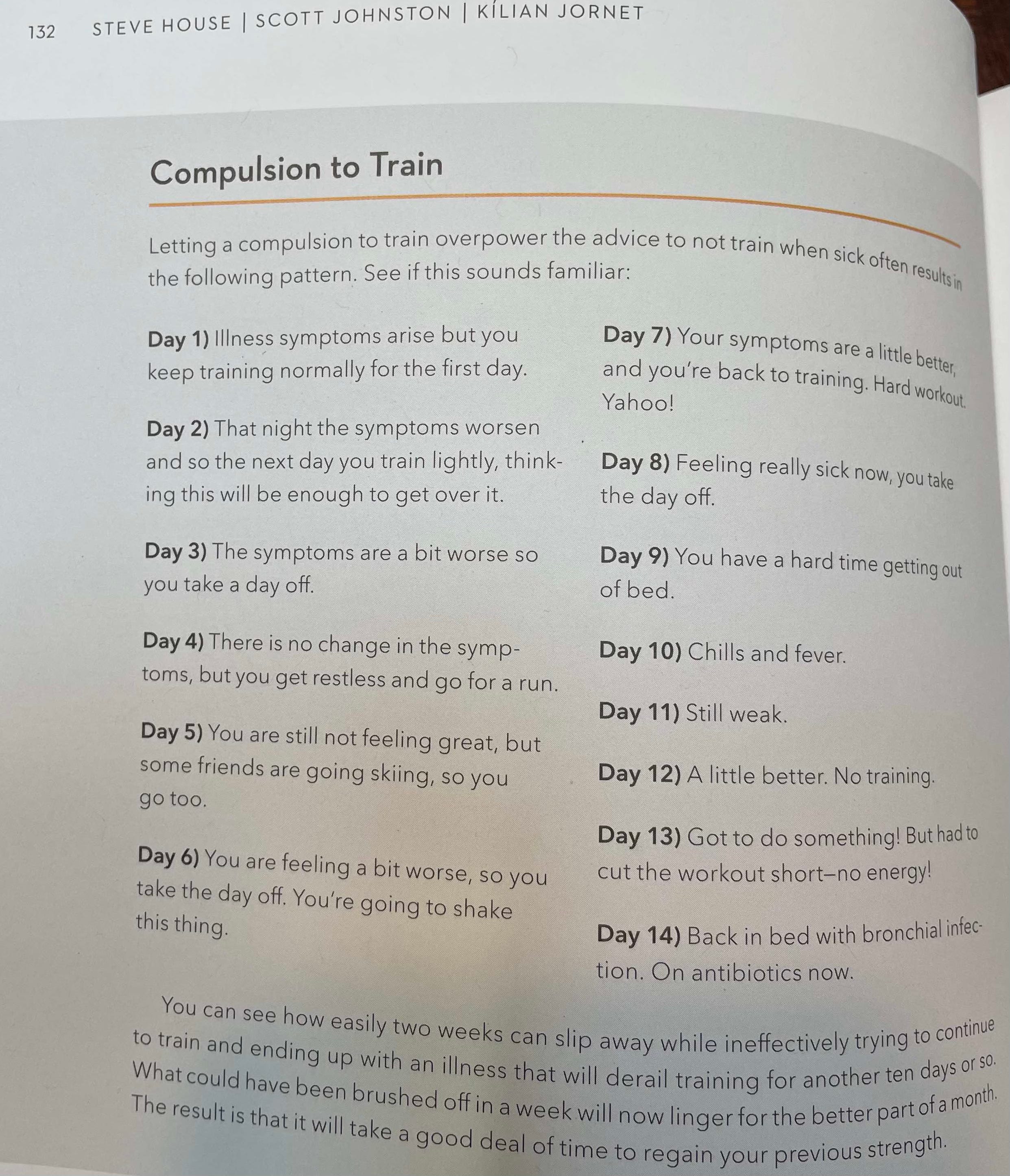
The pattern explained in the figure (above) will follow you everywhere. If you experience it with illness then you’re certain to see it with injury.
If you fall into the pattern in the photo then you’re looking at a wasted month. This article is going to explain a better way.
A Better Way
Back off at the first sign you might be dealing with illness. This could be a result of metrics tanking, unusually elevated training heart rate, a feverish feeling or a tickle in your throat.
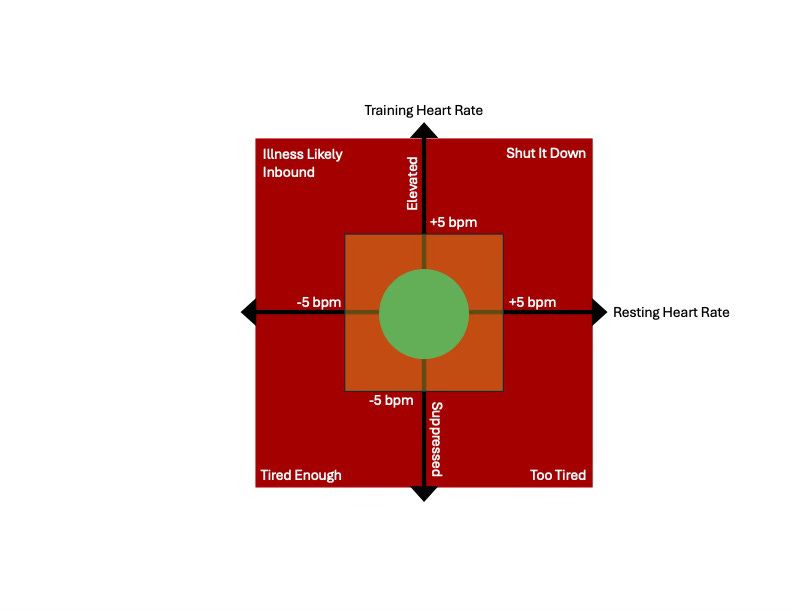
This early stage is the most difficult for athletes. Why? Because you have momentum and can easily continue to train for the next 48 hours.
Minimize The Depth of the Illness
Do not perform “one last solid workout.” This session, if you are about to get sick, increases the likelihood of a multi week setback.
By backing off immediately, and continuing to maintain core nutrition, our bodies will reallocate energy from exercise towards recovery & adaptation.
At this stage, nothing has been lost. We have brought forward the timing of our normal weekly low-stress days.
Our focus shifts to movement for health and we wait and see if an illness arrives. If it does then, hopefully, it will be minor.
It’s OK to keep moving with light activity and walking, avoid structured and/or group training.
Metrics Will Tell Us What We Want To Hear
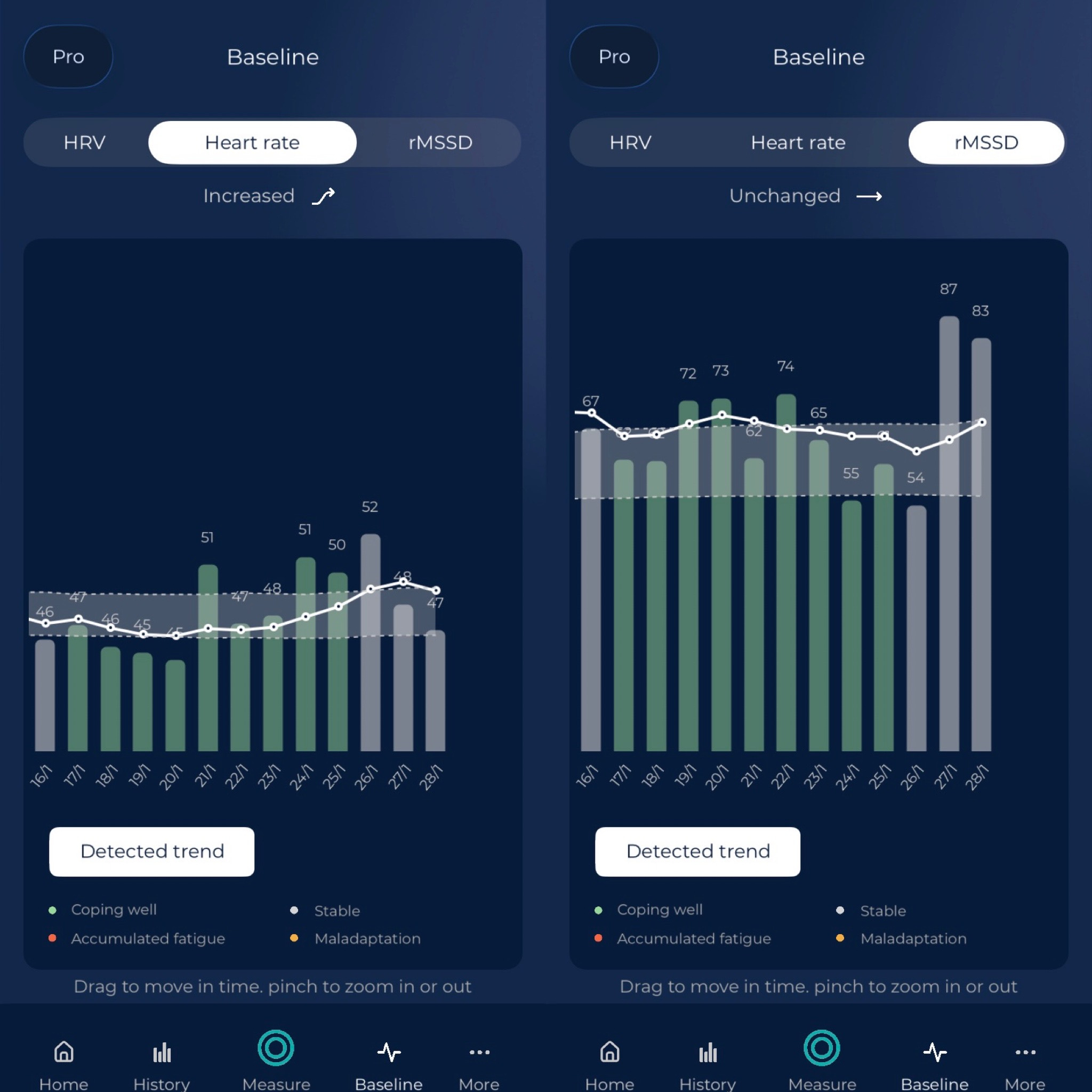
In the picture (above), from January 21st through 25th, the detected trend is “coping well.” But I’m not coping well, I know I have been infected with a virus. I don’t need my data to tell me what I can feel for myself.
This is the stage where the compulsion to train will lead you astray.
You know you’re mildly sick.
You still have momentum from earlier in the week.
You are scared to lose fitness, gain weight, disappoint your coach, lose your streak…
At this stage, nothing has been lost. You’ve taken 48-72 hours easy.
Keep moving for health, keep eating your core nutrition, don’t train.
Test The Waters
Your focus here is avoiding a relapse. Nothing has been lost at this stage.
After 72-96 hours, it will be clear if you are getting sick, or not.
If you’re getting sick then you’ll be grateful you didn’t compound things by training into illness.
If you’re not getting sick then you had the equivalent of a short unload block. I do these all the time and they have a positive impact on my long term gains.
Once the illness is gone, or doesn’t arrive, the first thing you do is add back frequency.
Bring back your normal exercise frequency, keep the intensity Easy / Zone 1, and cap session duration at not more than an hour.
Watch your energy ~4 hour after you exercise, if you feel a big energy dip then you’re still recovering.
Watch your evening RHR metrics for unusual elevation. Unusual is more than 5 bpm above normal.
Watch your sleep and overall energy. If sleep duration is up, and energy level is down, then you’re still recovering.
Easiest way to remember what I just said.
Train alone.
Cut your normal session duration in half.
Cap effort at heart rate Zone 1.
Return To Training
The duration of your illness should be counted from the first symptom being noticed to the end of all symptoms. Yes, your lingering, minor, not-really-a-cough counts.
The testing-the-waters phase (frequency focus, Zone 1) should last for at least half the days you lost to illness.
This implies 3-4 days for a minor illness, and
9-12 days for something that takes you out for a couple weeks.
At this point, I want you to do a Submax Test and compare the results (HR and Lactate) to your most recent healthy baseline test.
What you are looking for is elevated heart rate and lactate response. Elevated meaning more than 5 bpm/1 mmol above normal for heart rate / lactate.
You’ll find an example of normal, and significant, elevation from baseline when Bek tested following a multi-week illness.
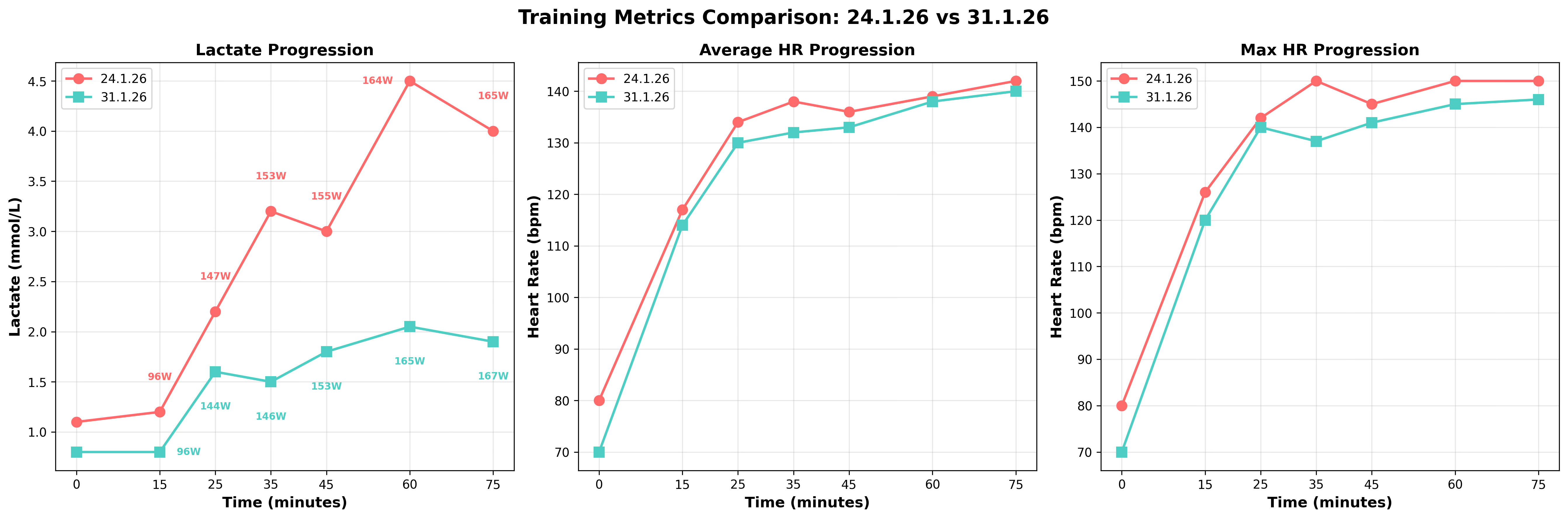
If you are materially elevated (Bek was +2 mmol) then you need another week focused on frequency with a Zone 1 cap. Toss in a little strength training if you are feeling good.
Keep watching for the ~4 hour post-workout crash and elevated evening RHR. Both of these are signs you need to be careful with total stress.
Pre- & Post-Illness Comparison
Testing example following minor illness of the author. This is the same illness tracked in the morning metrics chart (HR/HRV) at the top of this article.
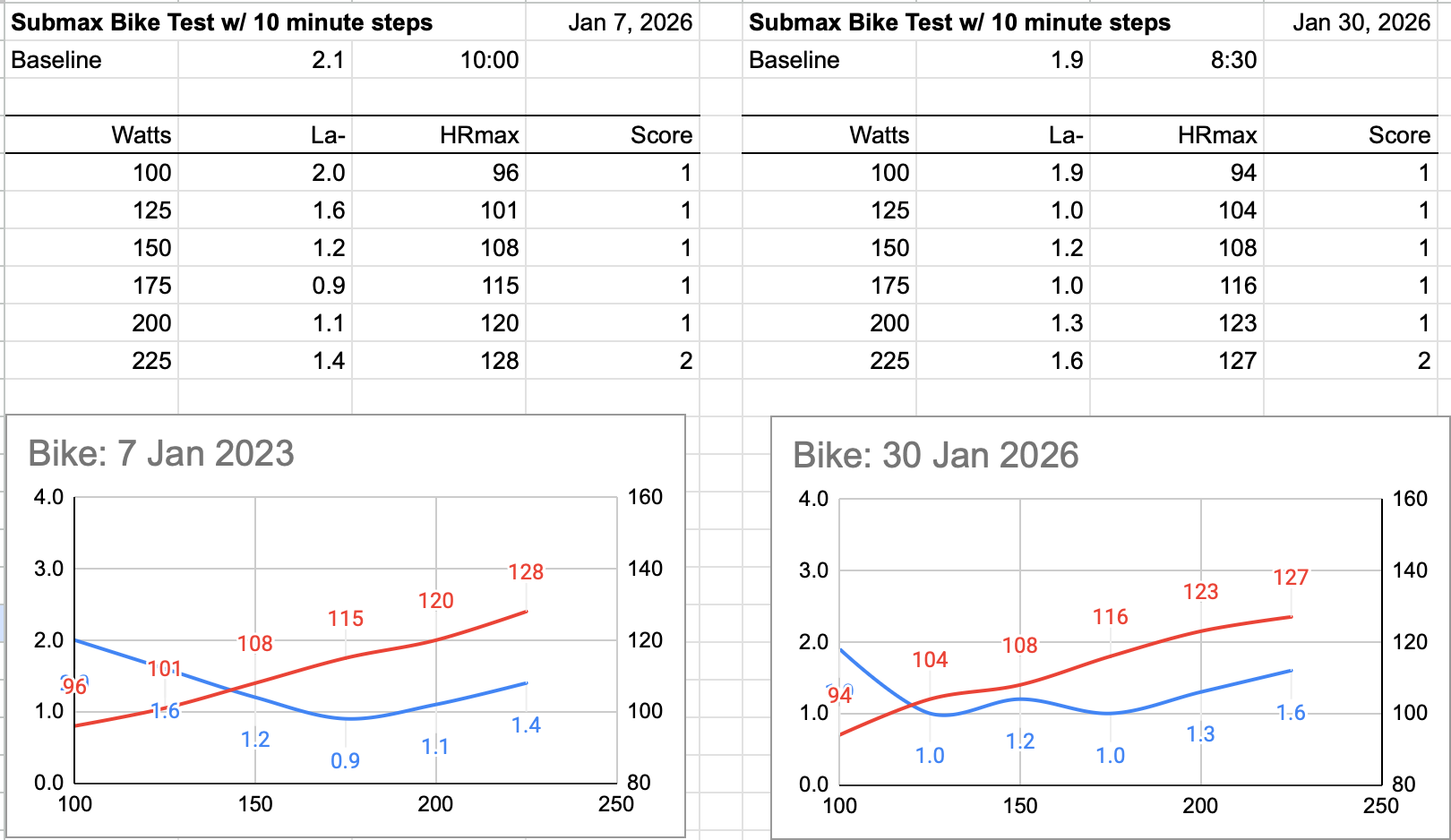
First symptom was January 21st (evening). Test on the left is healthy baseline. Test on the right is confirmation of return to baseline.
Once the submax test looks normal, return to your basic week.
If this entire process (first symptom to normal submax test) took <10 days then you’ll be OK to resume normal training, including intensity.
If the process took more than 14 days then you should repeat your basic week, twice, without challenging main sets. After those two weeks, you’ll be good to resume normal training, including intensity.
Wait until your lungs are completely clear before doing any sustained intensity.
Additional Resources
Two articles from the archives.
The first includes a case study with a classic “HRV collapse” response.
The second touches on the mental side of chronic illness as well as advice for times when training response disappears without a clear medical diagnosis.
Thanks for this! great checklist!
The urge to get back from illness and straight away jumping to high volume might seem the correct way to train for the missed workouts but viewing from a broader perspective, it isn't.
When an athletes gets ill, they feel like they are missing the workouts, they will lose fitness, their ideal build up is hampered by this illness but in a couple of days I don't think so fitness is lost on physiological levels, for sure the consistency gets broken but it can be viewed as forced long rest by nature. Taking it easy day by day seems to be the best way to approach it.
Erin Mawhinney of Canada was in pretty good shape & had a great build up as her GOAL-A race was The Marathon Project but she got ill before the race. She started the race but had to drop after 10 KM mark as she was surely feeling the illness had an impact on her overall body. An almost a month later, she ran Houston marathon in order to redeem her opportunity as she had the fitness to run a pretty fast race. She showed up big time by running 7 minute PB 2:29:36. She also took the training lightly after her drop at Marathon Project in order to not bury her body into the ground, there is no point in running the race in training and emptying the tank in training. If it is done like this, the cookie crumbles in races for sure in a pretty nasty way where the athletes can run their best performances as the tank has been emptied in the training. We need to know how hard to train in order to run the races at its peak and when backing off or taking lightly is the best option for us.