
How To Train - Chapter Eleven
Getting Bike Fit

The process of getting bike fit has three components and should be tackled sequentially on an annual basis. First, we get generally strong. Next, we shift our general strength to sport-specific strength. Finally, we work towards fitness specific to our event.
Our race-specific phase has two considerations:
Use cycling to prepare for the total duration of our event; and
Prepare ourselves to tackle the specific nature of our goal event’s bike course.
Earlier we explored how I used cycling to prepare for the ÖtillÖ World Championships. Runners, especially marathoners and ultra-distance runners, should pay careful attention to my approach. This time, I was preparing for six massive days across an 11-day time horizon. Most days would be spent on my bike and cycling fitness would dominate my performance at the Alpe Tri.
Ask cyclists, and their coaches, to define fitness and you’ll often hear discussions about best-hour and best-five-minutes power. You might also hear discussion about watts-per-kilo at a Threshold / Zone 4 effort. While these metrics are interesting, they weren’t going to have the greatest impact on my summer performance.
I was preparing for an 11-day block, with 40,000 feet of climbing, the last ~9,000 feet of which would be in a triathlon. Success would depend on improving my general capacity and efficiency climbing in Zone 3. This type of fitness is not captured by short-duration tests. The only way it can be assessed is via long days, ideally, done back-to-back.
The main goal I set for myself was to ride 10,000 vertical feet, at any effort, and have my heart rate appear normal on a short transition run. In myself, as well as the many athletes I’ve coached, I’ve found the ability to keep HR looking normal versus power/pace is an excellent metric to measure durability, which is another name for general capacity. But one-day durability wouldn’t be enough. I needed to train the ability to go long many times within a two-week block.
One of my favorite mantras is work before work rate. This phrase is a reminder that before we can do something fast, we need to be able to complete it at any speed. To get the work done, I headed to Italy for a twelve-day training camp. Inside the 12-day block, I planned six key days. Towards the end of the trip, Axel and I would transfer to Sweden. The plan was a return to the island of Utö, the site of last year’s race difficulties. While the Utö SwimRun event wouldn’t match the difficulty, or duration, of the Alpe Tri, it would give me a chance to see friends and test my legs after a bunch of cycling.
Structuring A Training Camp
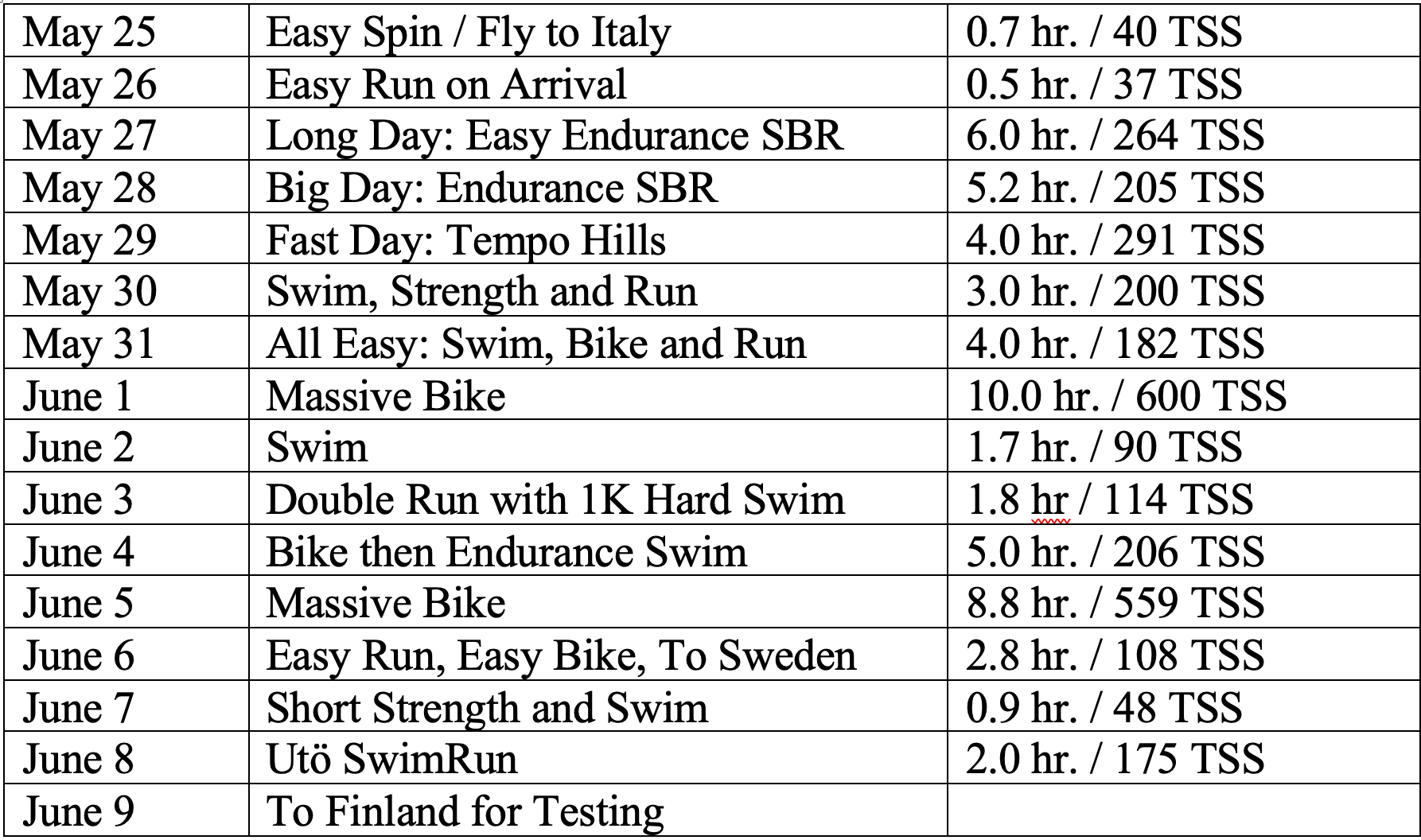
During a long training camp, we can either push volume or intensity. If we want to push both, then keep the camp shorter; three or four days lets us challenge ourselves without creating too much fatigue.
When it’s time for race-specific training, most everyone will find it best to stay in their normal routine and place a single race-specific day inside a normal training week.
