
Three Techniques You're Discounting


I got to spend last weekend in Jackson as part of a six-day unload. Justin was there and he wrote a few thoughts up on his Substack…

My favorite part of the conversation was Justin’s observation…
I am not saying that sticking with something will guarantee success in any pursuit, but I do think that abandoning pursuits too early is what creates the greatest separation between those that make it and those that do not.
Justin made the point that there can be excellent reasons to abandon pursuits. In fact, a key part of creating a life with meaning is the ability to simplify both daily actions as well as what we’re working towards. This is going to require a fair amount of abandoning.
Today I want to expand on Justin’s concept as it applies to sport. You’ll need to decide for yourself if being intelligently stubborn (with sport) is right for you.
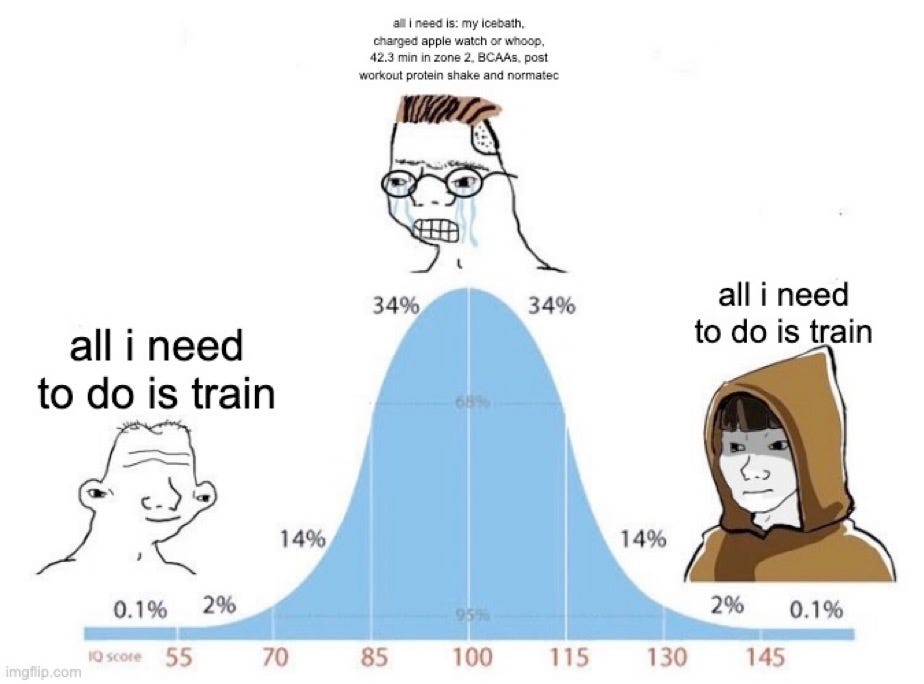
If not quitting is an important factor in our ultimate development then what’s strategy is most likely to keep us in the game?
This is a vastly different question from the way training strategy is typically presented - ie as an optimization problem.
How might we keep ourselves in the game? I promise you will discount what I’m about to explain. How do I know?
Because I have to constantly remind myself that these methods work.
Because they seem counterintuitive to the way our brains are wired.
Stress & Adaptation
Half our days should be low stress. This applies up and down the performance ladder.
If I could make a prediction for the future of exercise physiology then it would be this… we will better understand the role of the nervous system in all aspects of performance.
Talk to world-class strength and speed athletes and you’ll hear a deep respect for the role of the sympathetic system. Endurance athletes tend to discount this lesson in their own programs, piling on chronic stress.
I think it goes further than the output side of the performance equation. My experiences with half my days being easy1 point towards adaptation and total work capacity being intimately linked to how my nervous system is doing.
At this stage, beyond morning resting heart rate (RHR), training heart rate (THR) and morning heart rate variability (HRV)… we don’t have a lot of tools to measure how we’re doing. Knowing my bias towards chronic fatigue, my heuristic is to ensure half my days are low stress. I think you should do the same.
Note low stress doesn’t mean no stress. You’ll want to stay active everyday.
Easy Volume
Just like we underestimate the adverse impact of chronic fatigue, we discount the value of easy volume. Outstanding metabolic fitness, and movement economy, is something I seldom come across in amateur populations.
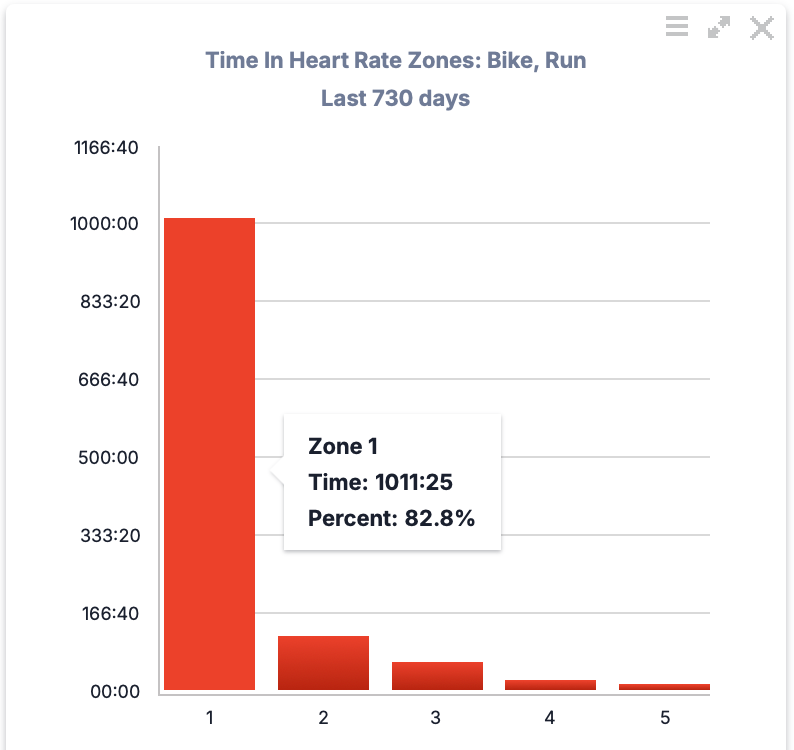
Over 90% of what I do is in the Green Zone (Zones 1 & 2).
When you add my swimming volume, I’m performing ~12 hours a week of Zone 1 training. Easy means heart rate, subjective perception, breathing and lactate are comfortable. This is a powerful stimulus for strengthening training response as well as an important component of performance at all intensities.
Athletes need constant reassurance to slow down enough, and for long enough, to get the training benefits that accrue from easy volume. It’s a central theme of my book, How To Train.
Frequency
Because fitness is a continuous function, even a single, short session makes a difference. The lower your chronic volume, then the more this principle will apply.
Frequency swims with long, relaxed intervals. At present, my favorite is 2x1,000. The first kilometer is swum with a pull buoy and the second kilometer is swim with fins. I choose one aspect of my stroke and focus on improving it. The long intervals train my mind to relax and make my middle distance intervals easier mentally.
Frequency runs where the goal is simply to run as easy as possible. I’ve always used these with athletes of all abilities. Whether it’s a professional athlete running 4 minutes per km or an amateur running 6 minutes per km.
Exercises from my physical therapist (PT Exercises)2. One of my PTs shared something that stuck with me, “Even if you only do them once a week, these exercises will work.” Talking with Justin this past weekend, he also shared the observation that, “if an athlete is too tired to do the little things then they are clearly too tired.”
My PT Exercises have a dual function:
Prevent small issues from derailing my training.
Acting as an early warning system for when chronic fatigue is starting to impair training response.
A Virtuous Circle
Ample low-stress days, easy volume & frequency work together to reinforce our training adaptations. The best part about this approach is it takes the pressure off the vast majority of our sessions. Our goal is to enjoy ourselves and stay in the game. This frees our mind to focus on the handful of sessions we will find challenging. If your approach requires you to constantly amp yourself up then it’s not going to prove optimal, or sustainable.
Not just my experience, radical recovery is a central feature of Nils van der Poel’s training approach.
Article and a video coming to show you my routine. I use standard exercises you can find on YouTube.
So much good here. Really looking forward to those PT exercises.
I can confirm a few random exercises I selected from youtube has been hugely beneficial for me. I can imagine how useful the ones from Heather are going to be.
My mobility always gets neglected when im feeling tired. Its something ive always kinda known. I keep soldiering on and feel guilty about not doing it, but seeing it written here has made me more aware of it and to make a plan for when it happens (rest)